October 3, 2025
First Blood: The Science of Bleeding
Menstruation Papers – Part 2
Blood is everywhere in our society. It is on the daily news, in newspapers, in religious imagery, in television shows and films. Yet menstrual blood is never mentioned and almost never seen, except privately by women. Yes, we have graduated from showing blue liquid in period commercials to red liquid, but a girl’s first period is usually still a secret.
It is kept secret because it is treated as a source of embarrassment and irritation. Menstruation in our society is invisible and irrelevant. It is properly hidden — and deemed shameful and unclean if it is not.
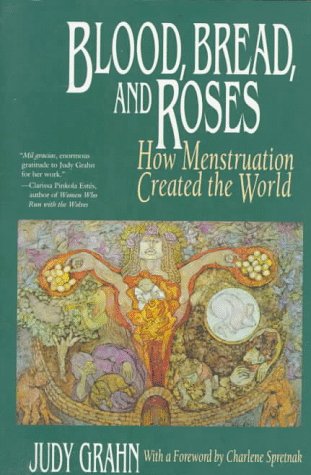
But it was not always this way. Long ago, in cultures across the world, a girl’s first menarche was a time of celebration and initiation. It was marked by ceremony, often including special clothing, sacred foods, and a period of seclusion. Far more than a biological event, menarche was recognized as a mark of female power, a source of ritual and awe.
The influence of these early menstrual rites remains visible in our society and culture even today. The echoes are there in the material world: why women wear lipstick and eye makeup; why they adorn themselves with earrings and hair clasps; why Indian women wear the red bindi or sindoor. Even the origins of forks, bowls, chairs, rugs, shoes — and high heels especially — can be traced back to ritual practices that grew out of menstrual symbolism.
There are also deep and profound connections between ancient menstrual rites and the development of agriculture, mathematics, geometry, writing, calendars, horticulture, architecture, astronomy, cooking, money, and other realms of knowledge. Blending archaeological data, ethnography, myth, folklore, history, and anthropology, we can construct a new myth of the origin of humanity — one that places menstruation at its center, and redefines what makes us human.
Human culture itself has been a weaving between the genders, a sharing of wisdom derived from menstruation. Interpreting these ancient menstrual rites gives us a new and more complete story of our beginnings. Many women’s traditions, across time and place, are based on the integration of body, mind, and spirit. Understanding menstruation — in its full cultural, spiritual, and biological significance — is one step back in that direction.
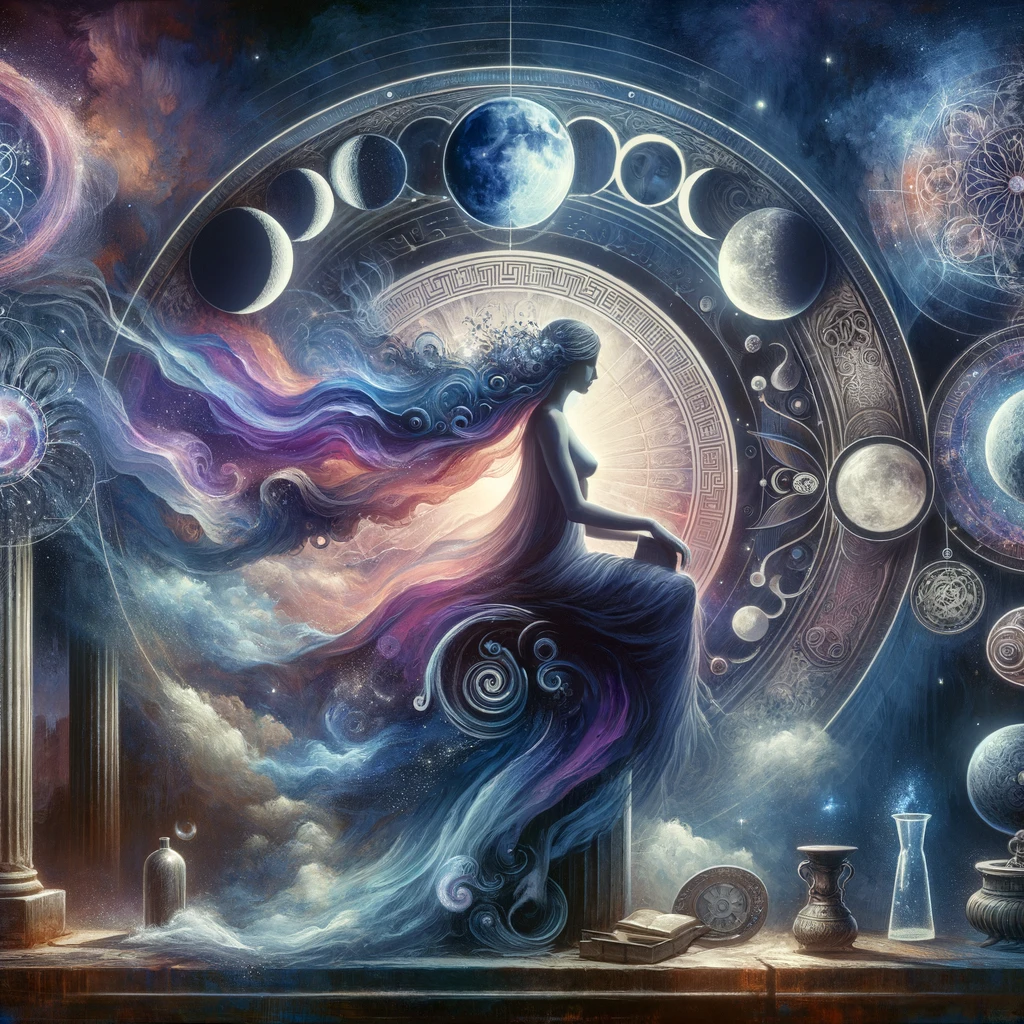
For centuries, menstruation has been described through the language of taboos and prohibitions. Folk traditions across cultures preserve long lists of do’s and don’ts for menstruating women — what they may eat, where they may go, what rituals they must avoid. But very rarely are the underlying reasons articulated. Too often, the “why” and “how” remain hidden.
This is what the word “occult” really means — not sinister, but hidden. Knowledge that is not explained, only passed down. For those who accept without question, no curiosity arises. For those who discard it all as superstition, the deeper meanings vanish along with the outer practice. But truth, when discovered, becomes knowledge; when ignored, it hardens into delusion.
My own interest in this topic sharpened through the work of Sinu Joseph, who has spent more than a decade traveling across India, speaking with women, exploring indigenous sciences, and reading ancient texts on menstruation. What she discovered is something I have also seen: that many cultural practices around menstruation, while dismissed as “taboo,” often have protective and healing logic behind them.
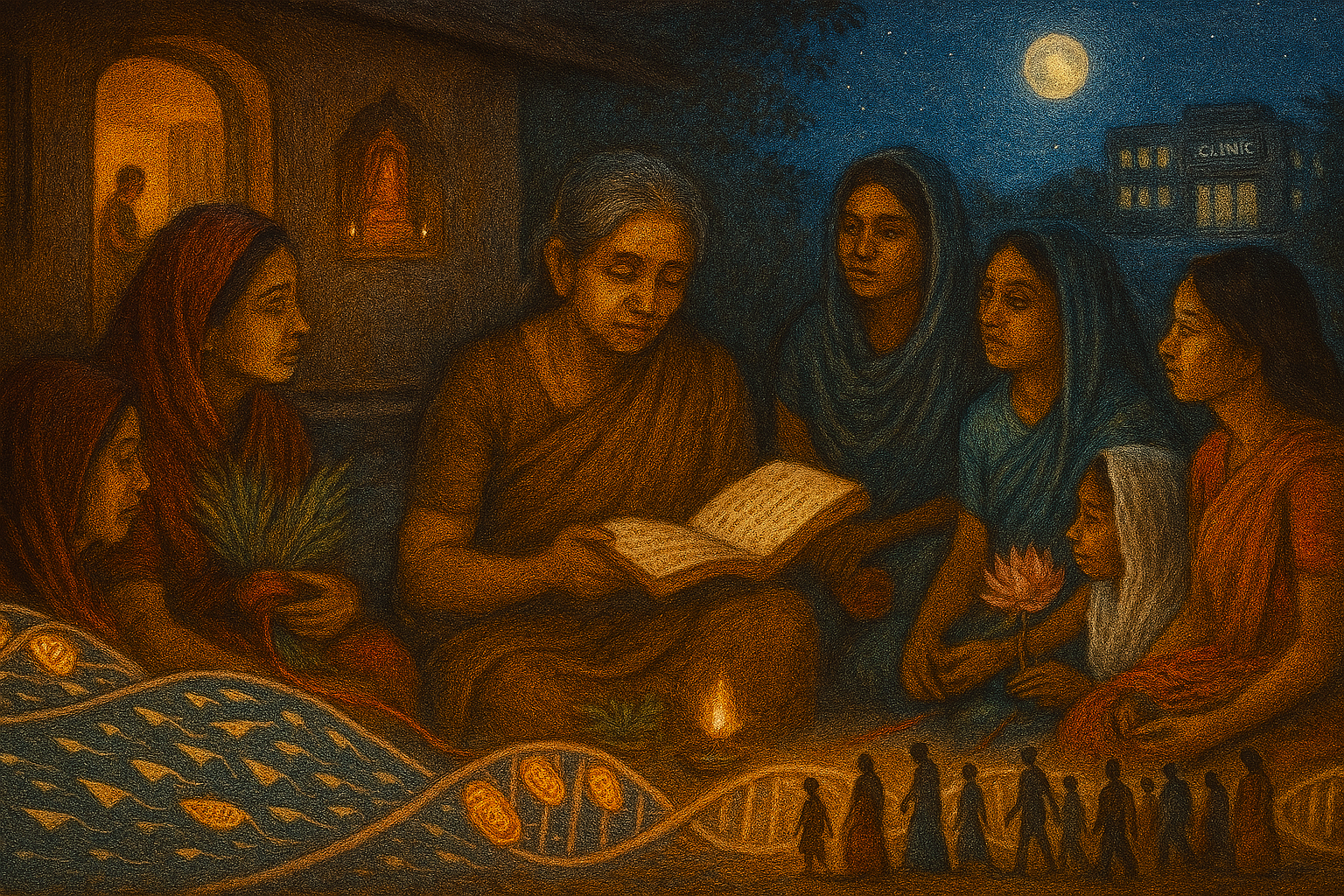
The difficulty is that ancient knowledge systems have been dismissed as “alternative,” and the sciences that underpin them are not acknowledged by mainstream academia. To understand them requires a bridging of worlds — mythology, the work of psychologists, women’s lived experience, biology, and cultural history — all of which risk being misinterpreted if studied from only a Western, male, or purely clinical lens.
The Odyssey of the Sperm and the Sovereignty of the Egg
To enter the body is to enter a cosmos. And nowhere is this more apparent than in the odyssey of conception.
The Song of Songs — a startlingly erotic love poem buried in the middle of the Bible — reveals a vision of female sexuality that is equal, vivid, and life-affirming:
“Your navel is a rounded bowl that never lacks mixed wine … Your belly is a heap of wheat set about with lilies. Your two breasts are like two young roes that are twins …”
Scholars have long argued about what “navel” really means here. Is it literal? Is it a poetic cipher for the womb, the basin, the birthplace? Some suggest it refers to the “door” between the born and the unborn. And when the text speaks of “mixed wine,” it is almost certainly not wine at all, but the mingling of sexual fluids — the man’s semen, the woman’s juices. A celebration of the life-giving flow, not a shaming of it.
Yet this vivid affirmation of female sexuality is precisely what later traditions tried to suppress. In the New Testament, the female image splits into two halves: Mary Magdalene, who had sex but bore no child, and Mary the Virgin, who bore a child without sex. Between these poles — prostitute and virgin — the fullness of woman is fractured.
Across cultures, menstruation became taboo: sex during bleeding was forbidden, feared to produce monsters, to invite Lilith, the dark bride of Adam. What remained permissible was only the procreative aspect of woman’s nature — the “white flow” aligned with conception. The red flow, the “river of death,” was cast as impure. Yet this very red current holds another truth: love beyond reproduction, creativity beyond the womb, the power to give birth not only to children, but to ideas, visions, art, and culture itself.
This duality is biological, too. Every woman knows she has two kinds of flow — the fertile and the infertile. But biology is not destiny in a simple sense. For even here, agency lies not with the sperm but with the egg.
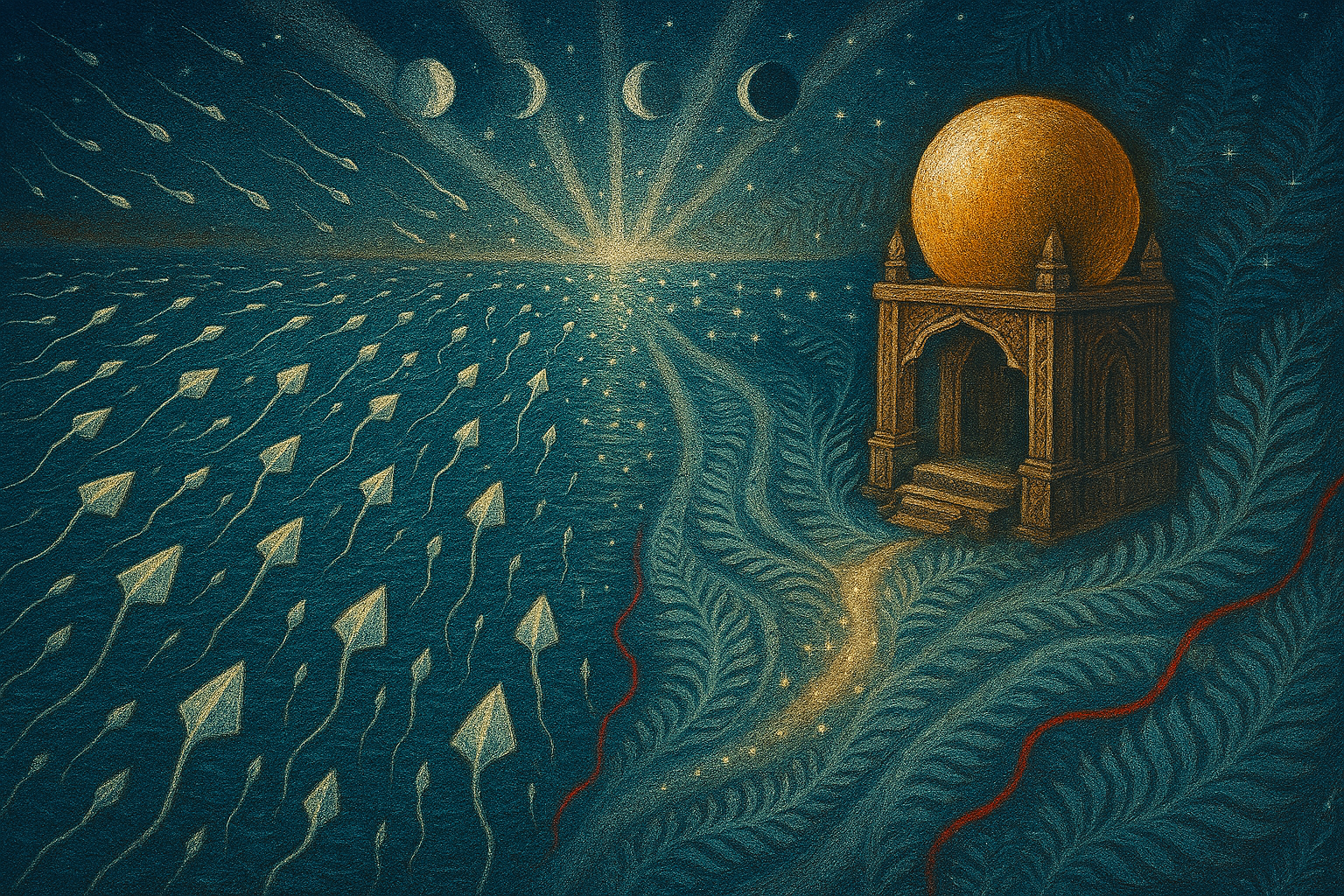
Science tells us that sperm carries either an X or Y chromosome, supposedly “deciding” the sex of the child. But that is only half the story. The ovum chooses. Like a microcosmic swayamvara, the princess-egg selects from millions of suitors. The uterus, too, must accept implantation. Conception is not simply a race of sperm but a layered negotiation within the woman’s body.
The voyage of sperm is perilous: through acidic environments that kill them, through labyrinthine cervix crannies known as the arbor vitae (“tree of life”), through mucous currents that open or close with lunar precision. Only during ovulation does the vaginal fluid become alkaline, easing the way. Only when the mucus “ferns” into pathways can sperm pass through. It is Odysseus’ journey through clashing rocks, and survival depends on timing, environment, and — crucially — the woman’s own arousal, orgasm, and bodily receptivity.
It is not the sperm that wins. It is the ovum that decides.
Eve’s True Inheritance
If we turn from sperm to the egg’s mitochondria, another radical truth emerges.
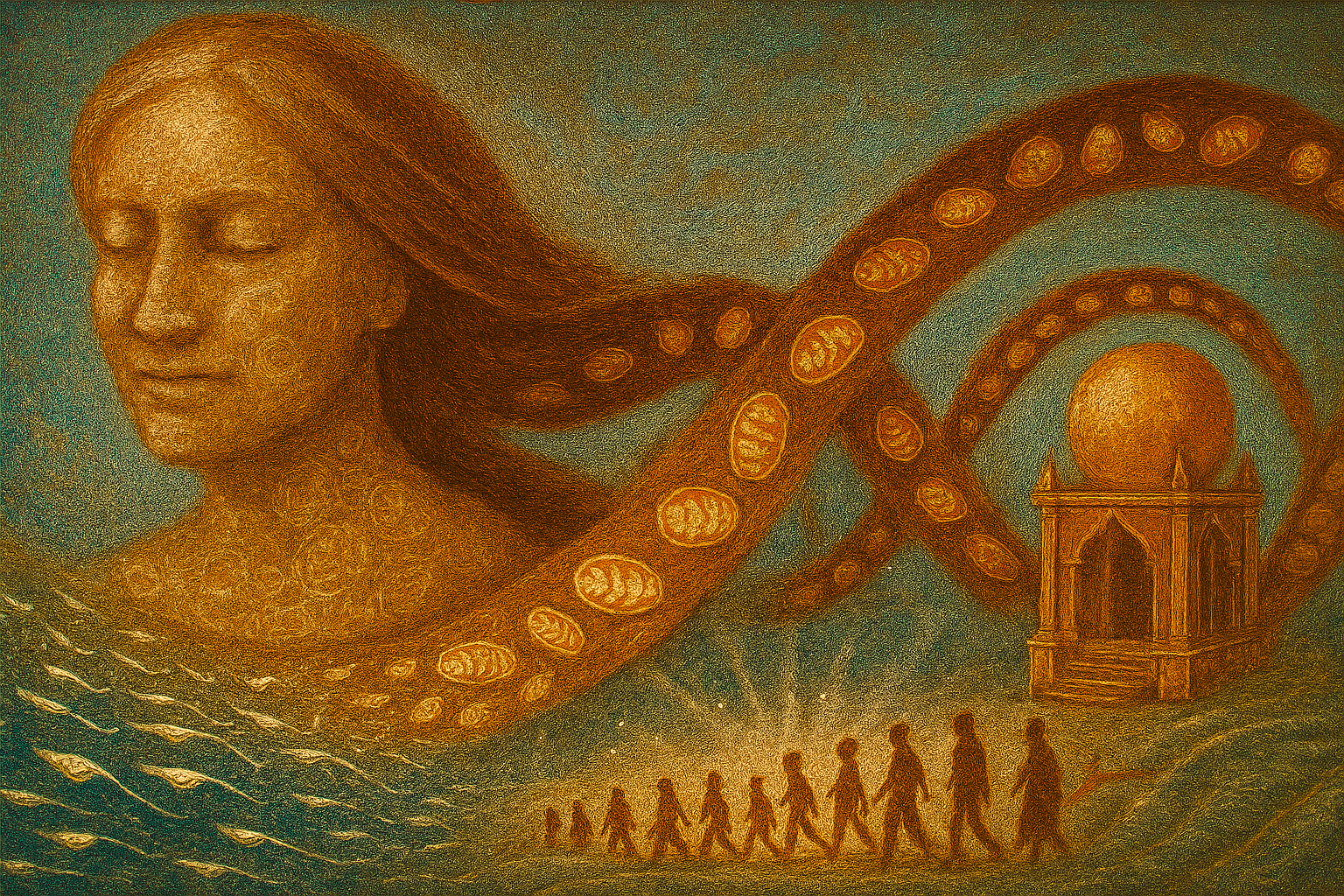
In 1963, scientists Margit and Sylvan Nass discovered DNA outside the nucleus, nestled within the mitochondria — the “powerhouses” of the cell. Unlike nuclear DNA, which comes from both parents, mitochondrial DNA (mtDNA) is inherited only from the mother. The father’s contribution vanishes.
This means that our most ancient ancestry — the unbroken line stretching back to the first human — is carried not through the father’s “seed,” but through the mother’s mitochondria. Biologists call this figure “Mitochondrial Eve,” the common matrilineal ancestor of all humans alive today. Every cell in our body hums with her inheritance.
Ironically, while cultures often exalt the male child as the bearer of lineage, it is women who carry the genetic memory of our species. The egg is not just a passive vessel; it is the living archive of humanity.
Beneath the Surface: The Fourfold Rhythm
Menstruation, then, is not merely a monthly inconvenience. It is the embodied clock of a woman’s inner cosmos. And yet, modern science has been astonishingly slow to describe it in its fullness. As late as 1930, scientists still debated whether the womb lining was shed, and ovulation timing remained unclear until mid-20th century research. Even now, consensus wavers.
What is known is that the menstrual cycle is a feedback system of exquisite sensitivity, linking body and mind in ways both measurable and mysterious. Hormone levels rise and fall, basal temperatures shift, cervical mucus transforms, skin resistance fluctuates, moods alter, dreams stir. Every organ, every rhythm, is tuned to this inner tide. And yet the scientific literature mostly catalogues the negative: pain, PMS, mood swings. Rarely do we see systematic accounts of the powers, intuitions, or heightened perceptions women experience during their cycles.
Culturally, too, these changes have been misinterpreted as weakness rather than wisdom. But if we pay attention, we see the cycle’s fourfold structure:
-
Pre-ovulatory ripening
-
Ovulation
-
Premenstrual decline
-
Menstruation
Four phases that mirror the four seasons, the four directions, the four lunar phases. Jung’s four faculties, the four humors, the four alchemical steps. Everywhere, the number four signals wholeness.
Menstruation is the body’s way of embodying cosmology. It is not just biology, but myth in motion.
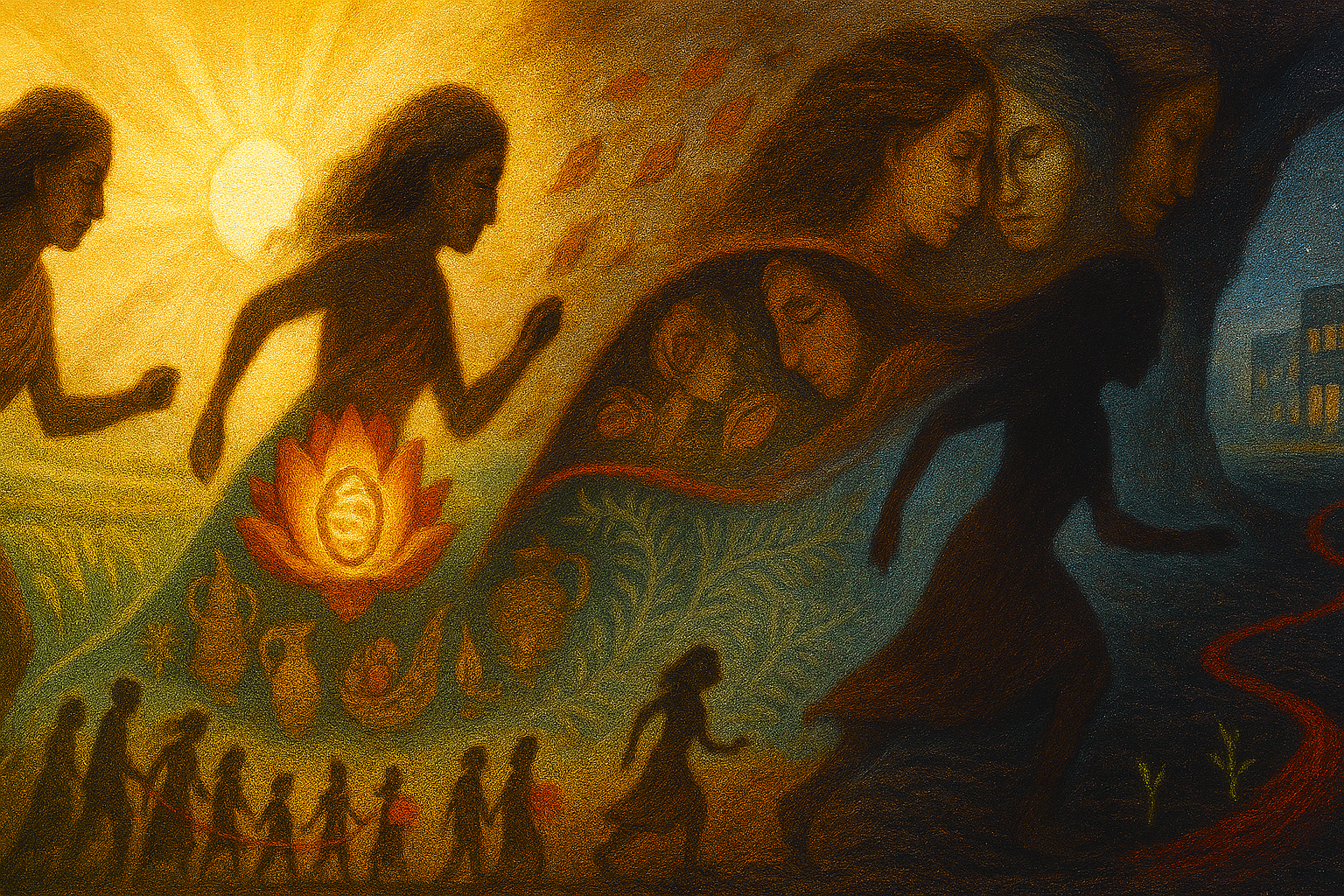
Toward Liberation from Fear
Now that modern medicine has made it possible for women to birth without fear and women can choose to give birth without overwhelming pain, there is no other natural function in women that is so accompanied by pain and distress as menstruation. Perhaps menstrual pain, like labour pain, is a learned response.
Can menstruation without fear be menstruation without distress? This is the subject of our next chapter.
Energy Medicine, biofeedback, and dream work all suggest that women can develop conscious participation in their cycles — inhabiting their bodies as sovereigns rather than strangers. Historical accounts even hint that women’s colleges once trained in techniques of introspection to influence conception and birth. What was possible then may be possible again.
To bleed each month in sorrow is not destiny. To bleed each month in awareness may be liberation.
First Blood is not just biology. It is cosmology. It is culture. It is consciousness. To reclaim it is to reclaim a power hidden in plain sight.
Originally published on Substack — view source