June 27, 2025
💰 Hidden Secrets of the Rupee — Part 1
The Origins of Money and the First Hyperinflation
When you think about money today, you probably picture a number on a screen, a colorful note in your wallet, or a QR code for UPI.
But here’s the real question:
What actually is money? Where does it come from? And why does it keep losing value?
The answers are far more ancient — and unsettling — than you think.
To understand the trap we’re in today, we have to travel back to the very beginning of money itself.
🛒 Barter: Where It All Began
Before money, trade was simple — you give me something, I give you something in return.
This is called barter, and it worked… until it didn’t.
Barter depended on what economists call the “coincidence of wants.” If you had a cow and wanted wheat, you had to find someone who both had wheat and wanted a cow — at the same time.
Trade was limited. Growth was slow. Civilization was stuck.
🧂 Early Prototypes of Money: Salt, Shells, and Sugar
To solve this, people began using commonly valued items — salt, spices, beads, seashells — as proxies for trade. These were early forms of money.
But they had serious flaws:
-
Spoiled easily
-
Hard to transport
-
Inconsistent value across regions
These weren’t scalable. The world needed a better medium of exchange
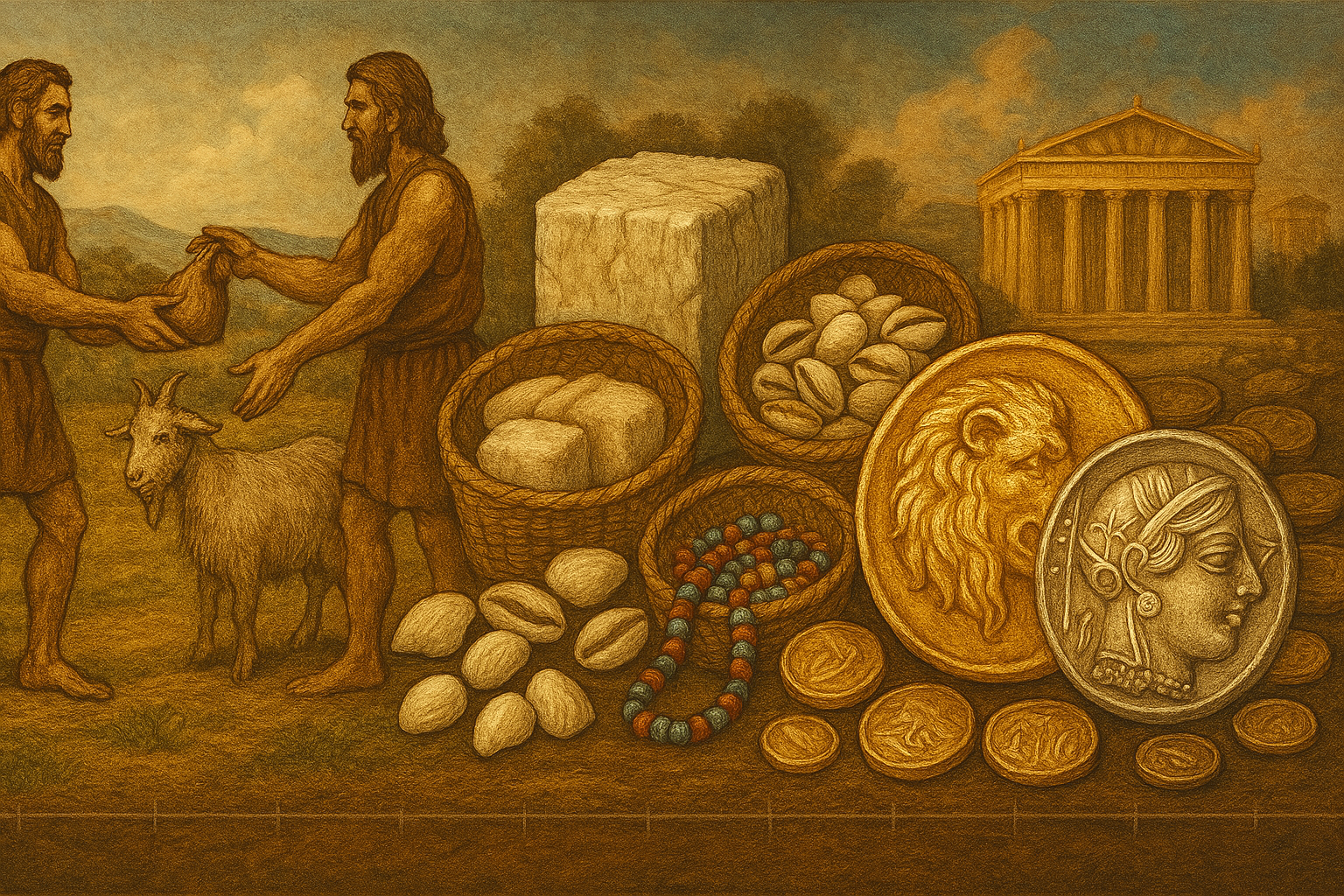
Salt, spices, beads, seashells were used as proxies for trade.
Enter Gold and Silver: The Birth of Sound Money
Humanity found its answer in the ground: gold and silver.
Why did these metals work so well?
✅ Rare and hard to produce
✅ Durable and divisible
✅ Recognized and valued everywhere
At first, people used them by weight. But that was messy and prone to fraud.
So the Kingdom of Lydia (modern-day Turkey) started minting standardized gold and silver coins. Trade exploded.
But it was Athens, not Lydia, that showed us what sound money could truly achieve.
🏛️ Athens: From Coinage to Collapse
Athens became one of the most powerful and enlightened civilizations in history — thanks in part to its silver-backed currency from the Laurium mines.
But then came war. And with war, came debt.
To fund the Peloponnesian War and large-scale public works, Athens turned to a familiar trick…
🔨 They melted down their silver coins, mixed in copper, and reminted twice as many coins.
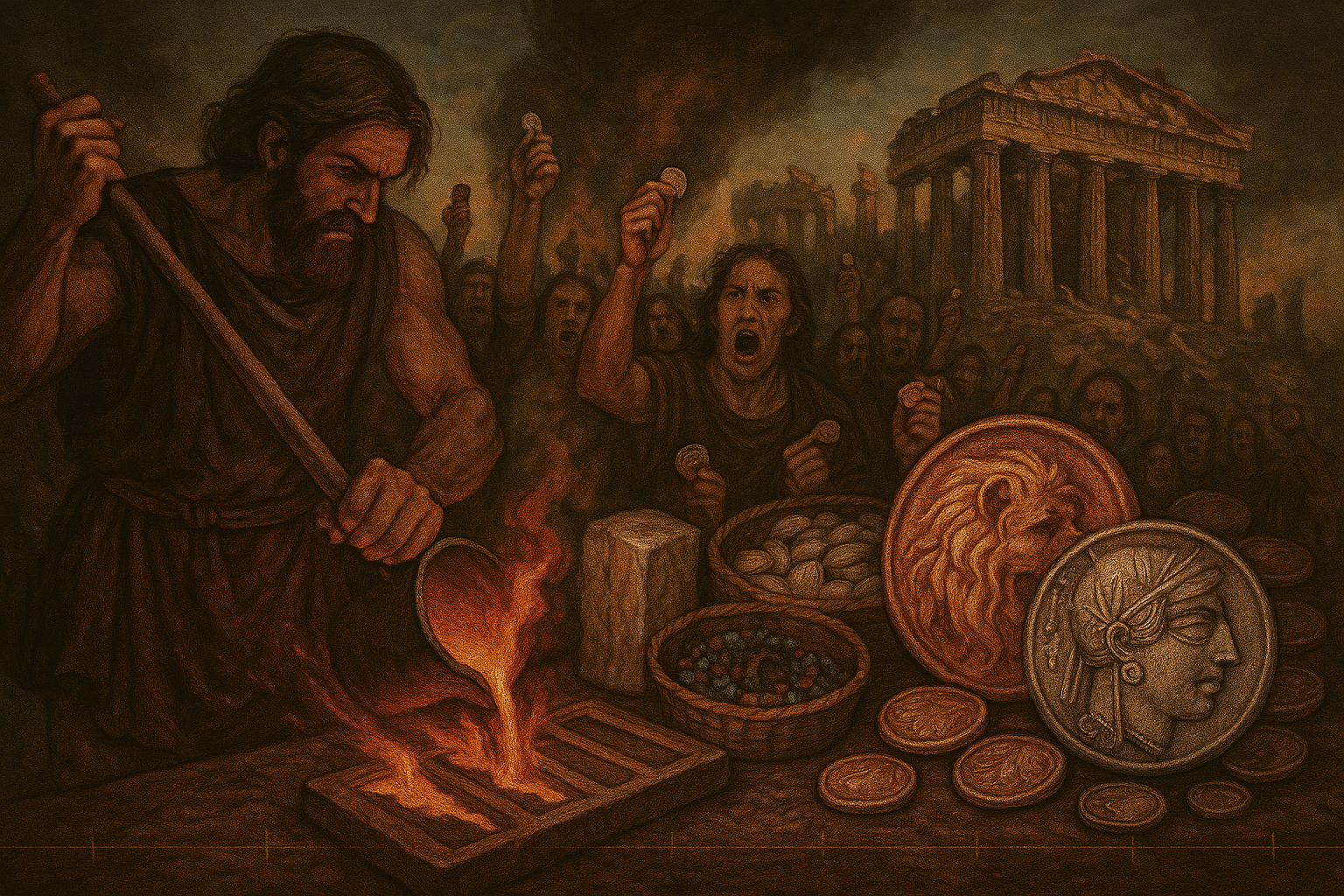
This was the ancient version of printing money.
It worked at first. But people noticed.
🧠 Gresham’s Law: “Bad Money Drives Out Good”
Once people realized their coins were being debased, they hoarded the original silver coins and spent the fake ones.
Real money vanished. Prices soared.
Athens experienced the first recorded hyperinflation in history.
And in 404 BC, financially broken and politically unstable, Athens surrendered to Sparta.
Lesson learned:
🧨 Debasing currency always leads to collapse.
💸 Inflation is not new — it’s a tool of the powerful to silently extract wealth.
Yap Island: Stones as Money?
Jump across the globe to Yap, a small island in Micronesia, where money looked very different.
Locals used rai stones — massive limestone disks — as currency.
Here’s why it worked:
-
Carved with great difficulty and shipped across dangerous seas
-
So big they couldn’t move them; ownership changed hands, not the stone itself
-
Value came from effort, scarcity, and social consensus
It wasn’t government-backed.
It wasn’t printable.
It worked because it was trusted.
But even Yap wasn’t immune to monetary manipulation…
💥 When Easy Money Destroys Trust
In 1871, an Irish-American trader named Captain David O’Keefe arrived on Yap and wanted to trade coconuts.
Locals didn’t care for foreign currency.
So he gave them what they did value: rai stones.
But instead of the traditional, difficult process…
He used explosives and ships to mass-produce and import them.
It broke the system.
The chief banned these “new” stones. But others accepted them.
Conflict erupted. Trust collapsed.
Even in Yap, easy money ruined the economy.
💡 The Pattern Is Ancient — But Still Alive Today
Whether it was ancient Athens or remote Yap, the lesson is always the same:
“Those who control the supply of money can quietly steal the wealth of those who save it.”
Modern inflation does the same thing.
Only now, it’s digital. Invisible. Quiet.
📊 Currency ≠ Money
This series will keep coming back to one essential idea:

Modern fiat currency — like the rupee — is not money. It’s currency: a government-issued token with no intrinsic value, no limit in supply, and no promise to retain purchasing power.
🧠 Final Thoughts
“All fiat currency eventually returns to its intrinsic value — zero.”
Inflation is not an accident. It’s a design feature.
And understanding this is the first step to financial sovereignty.
🔔 Coming Up in Part 2:
-
The death of the gold standard
-
The rise of fiat currencies
-
The secret behind modern inflation
-
Why saving in rupees is a losing game
Make sure you’re subscribed so you don’t miss it
.
Thanks for reading Harsh’s Substack! Subscribe for free to receive new posts and support my work.
Originally published on Substack — view source