June 29, 2025
Hidden Secrets of the Rupee — Part 3
How Money Is Actually Created (And Why You’re Always Getting Poorer)
In Part 1, we explored how money evolved — from barter to gold to coins.
In Part 2, we saw how the gold standard died, and how fiat currency was born.
Now in Part 3, we’re pulling back the curtain on something most people never learn in school:
How is money actually created today?
Spoiler: It’s not the government that prints most of it.
It’s not the RBI.
And it’s definitely not backed by anything scarce.
Instead, modern money is debt.
And every rupee that enters the system does so with interest attached — which must be repaid with more money that doesn’t exist yet.
Let’s unpack it step by step.
🏛️ Who Really Creates Money in India?
You probably assume the Reserve Bank of India (RBI) prints rupees, then distributes them to banks, ATMs, and UPI apps.
But that’s only a tiny part of the story.
Here’s how it really works:
💵 Step 1: Government Creates Bonds (IOUs)
To fund spending, the Indian government issues bonds — promises to repay debt in the future with interest.
🏦 Step 2: RBI Buys These Bonds (Monetary Policy)
The RBI buys these government bonds and creates rupees out of thin air in return. This increases the “base money supply.”
This is called Open Market Operations.
🧨 Step 3: Commercial Banks Multiply the Money
Here’s the twist: Commercial banks (like SBI, HDFC, ICICI) can lend many times more than they hold in deposits.
This is called fractional reserve banking.
-
If a bank has ₹1,000 in deposits, it can legally lend ₹9,000 or more.
-
That extra ₹8,000 didn’t exist before — it was created digitally as credit.
Every time a loan is issued, new rupees are born.
💥 Banks don’t lend money they have. They create new money with every loan.
🧮 Why This System Is Inherently Flawed
Let’s say you borrow ₹10 lakh to buy a car.
That ₹10 lakh is created on the spot by the bank. But the bank wants it back — with interest.
Suppose you owe ₹11 lakh total (₹10 lakh + ₹1 lakh interest).
Where does the extra ₹1 lakh come from?
It doesn’t exist yet — someone else must borrow more money into existence so you can pay back your loan.
This means the economy must keep expanding just to pay off old debts.
It’s a treadmill — one that never stops.
🔄 Why Inflation Is Built Into the System
Since money = debt, and debt needs interest, the system must constantly inflate.
Governments borrow.
Central banks print.
Commercial banks lend.
More money floods the system.
Result?
🧻 Each rupee becomes worth less over time.
📉 Your salary may rise, but purchasing power falls.
🛍️ What ₹100 could buy in 1990 now costs ₹1,000+.
📉 The Melting Ice Cube: Why Saving Rupees Doesn’t Work
If your money is losing value every year, saving in rupees is like holding:
-
🧊 A melting ice cube
-
🪙 A coin slowly dissolving
-
💸 A promise that gets weaker every day
You think you’re saving, but you’re silently being robbed.
🏦 The Lie of Bank Deposits
Here’s what most people think happens:
You deposit money into your bank. The bank keeps it safe.
Here’s what actually happens:
-
Your deposit becomes a liability for the bank
-
The bank uses your money as a reserve to lend out many times over
-
If too many people withdraw at once, the bank collapses
We saw this with:
-
🏦 Yes Bank
-
🏦 PMC Bank
-
🏦 Silicon Valley Bank (USA)
When banks fail, depositors are often the last to get repaid.
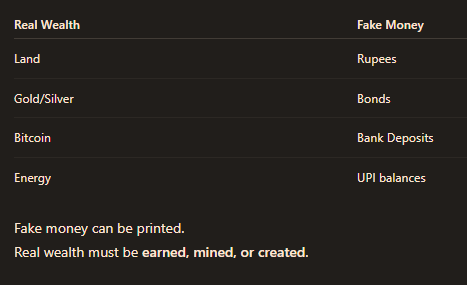
🔍 Real Wealth vs. Fake Money
There are two kinds of wealth:
🪙 The Bitcoin Breakthrough
Bitcoin flips this broken system upside down.
✅ Limited supply: Only 21 million will ever exist
✅ No central issuer: No RBI, no bank
✅ Verified by math: No politician can interfere
✅ Global: Portable and borderless
✅ Transparent: Every transaction visible
✅ Non-inflationary: Built to store value, not lose it
Bitcoin is the first form of digital sound money. It combines the scarcity of gold with the portability of the internet.
⚠️ Why This Matters Now
UPI, wallets, QR codes — they’re all just layers on top of a rotting fiat system.
If the base layer (the rupee) is losing value, it doesn’t matter how fast or cheap the payment is.
You’re still being robbed — just more conveniently.
🔓 Take Back Your Financial Power
Here’s what you can do:
-
Own real assets (land, gold, silver, Bitcoin)
-
Understand the system before you trust it
-
Don’t save in rupees unless you have to
-
Don’t rely on banks to “keep” your money safe
-
Learn about decentralized money
🧠 Final Thought
If money is created as debt…
And inflation is by design…
And saving is silently punished…
Then the only solution is to exit the system.
Bitcoin isn’t just “another investment.”
It’s a lifeboat off the sinking ship of fiat.
🔔 Coming Up in Part 4:
-
What UPI doesn’t tell you about your money
-
Why digital convenience can be dangerous
-
How programmable money can be used to control behavior
-
And the real agenda behind “Digital Rupee” and CBDCs
👉 Subscribe to stay ahead of the collapse — and prepare for the future.
Originally published on Substack — view source