July 1, 2025
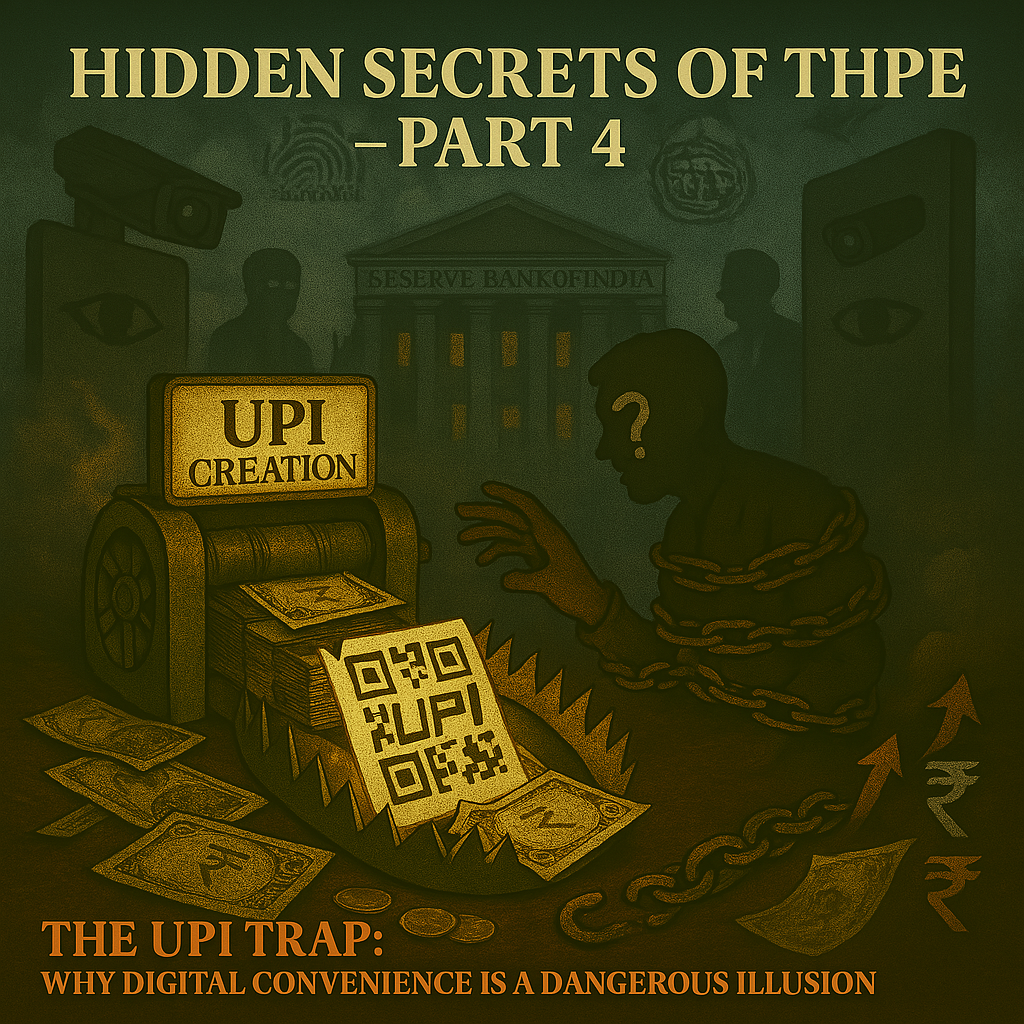
🏛️ Hidden Secrets of the Rupee: Part 4
The UPI Trap: Why Digital Convenience Is a Dangerous Illusion
So far, we’ve explored:
-
Part 1: The origins of money and how sound money made civilizations thrive
-
Part 2: The death of the gold standard and the rise of fiat currency
-
Part 3: How money is actually created today — as debt, by banks
Now, we move into the digital age.
A time when money doesn’t even feel like money.
📱 Just tap a phone.
💵 A number moves.
💡 It feels efficient, fast, safe.
But beneath the surface, digital payment systems like UPI (Unified Payments Interface) come with hidden risks no one talks about — and massive implications for your privacy, freedom, and financial future.
The UPI Trap: Why It’s Not Just a Payment App
UPI has transformed India’s payment landscape. It’s now one of the world’s most advanced payment systems.
But here’s the uncomfortable truth:
UPI is the front-end of a deeply flawed and dangerous monetary system.
It’s not just a tool.
It’s a trap — and here’s why.
💡 UPI = Surveillance Payments
UPI transactions are:
-
100% trackable
-
Logged permanently
-
Shared between banks, NPCI, and government systems
-
Vulnerable to behavioral control and algorithmic targeting
You’re no longer paying with cash (anonymous, bearer-based money).
You’re paying with traceable code — and that means:
Your financial life is now visible, stored, and controllable.
🔒 Cash = Freedom | UPI = Control
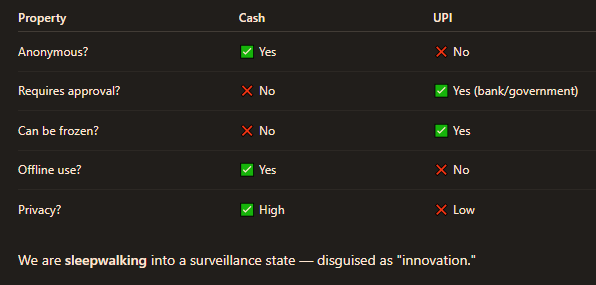
We are sleepwalking into a surveillance state — disguised as “innovation.”
🏦 Banks Don’t Hold Your Money
When you use UPI, you’re accessing a bank account.
But here’s what you may not know:
-
Your deposits are not stored safely in a vault.
-
They’re used to issue loans and credit.
-
Banks can lock, limit, or freeze access — as seen with PMC Bank, Yes Bank, and others.
In a crisis, your money can vanish.
And all UPI would show is: Balance Unavailable.
🧨 CBDCs: The Final Step to Total Control
UPI is just the beginning.
Governments around the world (including India) are developing Central Bank Digital Currencies (CBDCs) — digital rupees directly issued and controlled by the RBI.
Sounds harmless? Think again.
A CBDC:
-
Can be programmed (e.g., expires if not spent)
-
Can be restricted by location or purchase type
-
Can penalize you for “undesirable behavior”
-
Can be linked to social credit systems (as in China)
If cash is freedom, CBDCs are digital handcuffs.
🎯 What’s the Endgame?
Here’s the likely roadmap:
-
Promote UPI → Remove cash from circulation
-
Push Digital Rupee (CBDC) → Integrate with Aadhaar/UID
-
Centralize control of every rupee in circulation
-
Gain power to freeze, limit, or penalize at will
All in the name of “safety,” “anti-money laundering,” and “digital progress.”
But in reality? It’s about control.
🧠 Why Bitcoin Changes Everything
Bitcoin is everything fiat and UPI are not:
-
✅ Fixed Supply: Only 21 million
-
✅ Decentralized: No central authority
-
✅ Permissionless: No one can stop your transaction
-
✅ Borderless: Works anywhere, for anyone
-
✅ Transparent: But pseudonymous
-
✅ Immune to inflation: No one can “print” more
Bitcoin is cash for the internet — with none of the surveillance.
It’s not just an asset. It’s a parallel system — built for freedom.
🔐 Why This Matters (Now More Than Ever)
Every time you scan a UPI code, you’re making a trade:
-
Convenience over control
-
Speed over sovereignty
-
Software over security
You’re slowly handing over your ability to opt-out, speak out, or exit — without even realizing it.
And one day, when the system collapses, or your views aren’t acceptable, or your behavior is flagged…
Your UPI might still work —
But your balance will say ₹0.
🧭 How to Protect Yourself
✅ Diversify your savings: Gold, silver, Bitcoin
✅ Keep some cash: Always have an offline backup
✅ Learn about self-custody: Don’t trust banks blindly
✅ Question convenience: What are you giving up in return?
💬 Final Thought
“The further a society drifts from the truth, the more it will hate those who speak it.”
— George Orwell
UPI isn’t evil — but it’s not neutral either.
It’s a step toward a future where every rupee is traceable, every transaction is judged, and freedom is optional.
Don’t wait until it’s too late.
🔔 Coming Up in Part 5:
-
Why saving in rupees guarantees a loss over time
-
How inflation steals your wealth without your consent
-
What “sound money” really means
-
And how to transition out of the system — one rupee at a time
Originally published on Substack — view source