October 2, 2025
Menstruation: The Forgotten Mystery
Menstruation Papers, Part I
For centuries, the monthly cycle known as menstruation has been veiled in secrecy and clouded by misunderstandings. While discussions on modern cleanliness and hygiene are common, the cultural customs related to menstruation are often overlooked. These practices, sometimes labeled as mere “taboos,” actually carry profound wisdom waiting to be rediscovered.
Instead of disregarding them as outdated remnants of the past, let us embark on a journey of comprehension. This exploration must go beyond the clinical view of science and into the rich realm of cultural beliefs, ancestral traditions, and lived experience. Science explains processes in terms of hormones and reproduction, but it cannot capture the subtleties of inner experience—the fatigue, the psychic sensitivity, the symbolic depth that women have always felt at this time.
This series begins by acknowledging something simple yet radical: menstruation is not just a biological event. It is a cultural tapestry, an energetic threshold, a philosophical mystery, and even—if we allow ourselves to see it—a spiritual initiation repeated each month.
First Blood: The Anomalies of Human Menstruation
For something that women do every month, we know surprisingly little about menstruation. It is one of the most universal experiences among women across the world, yet it remains poorly understood—not only by men, but often by women themselves.
We are taught what to do during these times: what to eat, what to avoid, how to manage hygiene. But very little is said about why this process unfolds the way it does.
Biologically, science explains menstruation as the shedding of the uterine lining when conception does not occur. But beyond this clinical description lie striking anomalies: human menstruation is unlike almost anything else in the animal kingdom. Very few mammals menstruate. Fewer still bleed visibly. And none bleed to the extent that human women do—losing such a quantity of blood that it can interrupt daily life, and sometimes even incapacitate.
Why would nature design such an elaborate and costly system? Why do humans, unlike other species, carry such a heavy monthly burden?
Entire industries have emerged to manage this cycle. From disposable pads to silicone menstrual cups, “menstrual hygiene” has become its own marketplace. We know how to handle the material effects of menstruation—but do we understand the energetic, emotional, and psychic dimensions? These remain, for the most part, uncharted.
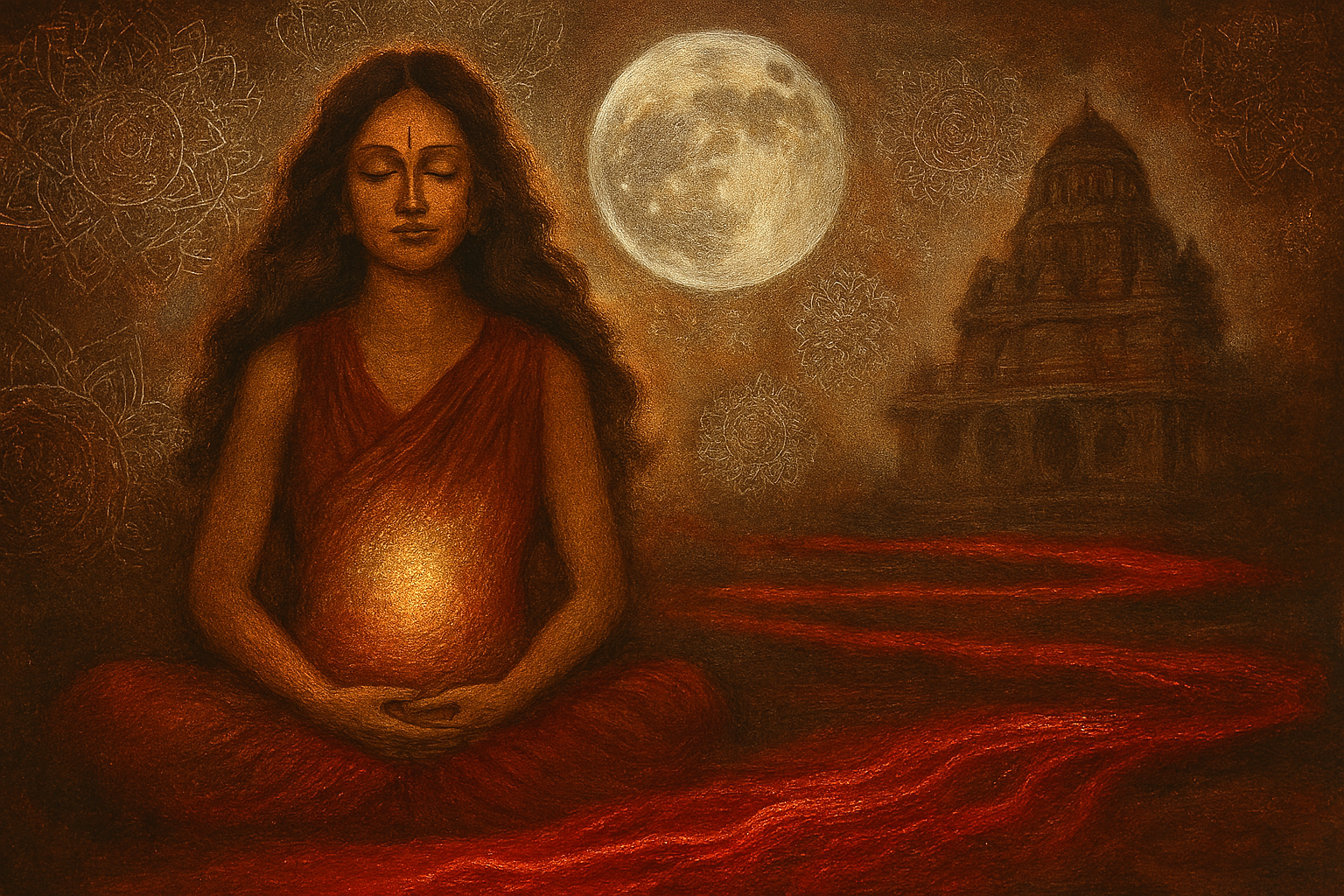
Traditionally, menstruation was a time of withdrawal and reflection. Ancient cultures often honored it as a sacred rhythm, a period imbued with mystery, aligned with the cycles of the moon. In India, menstrual cycles often coincide with festivals—sometimes falling during Navratri, when the Goddess is celebrated externally in temples and pandals. Yet the Goddess is also within: embodied in every woman who bleeds at that very moment.
Paradoxically, at the same time that temples celebrate the feminine divine, many women refrain from entering those very temples during their period. Modern minds call this contradiction “superstition.” But perhaps it is a symbolic recognition that menstruation itself is a temple—a sacred process of inner purification—requiring respect, not rejection.
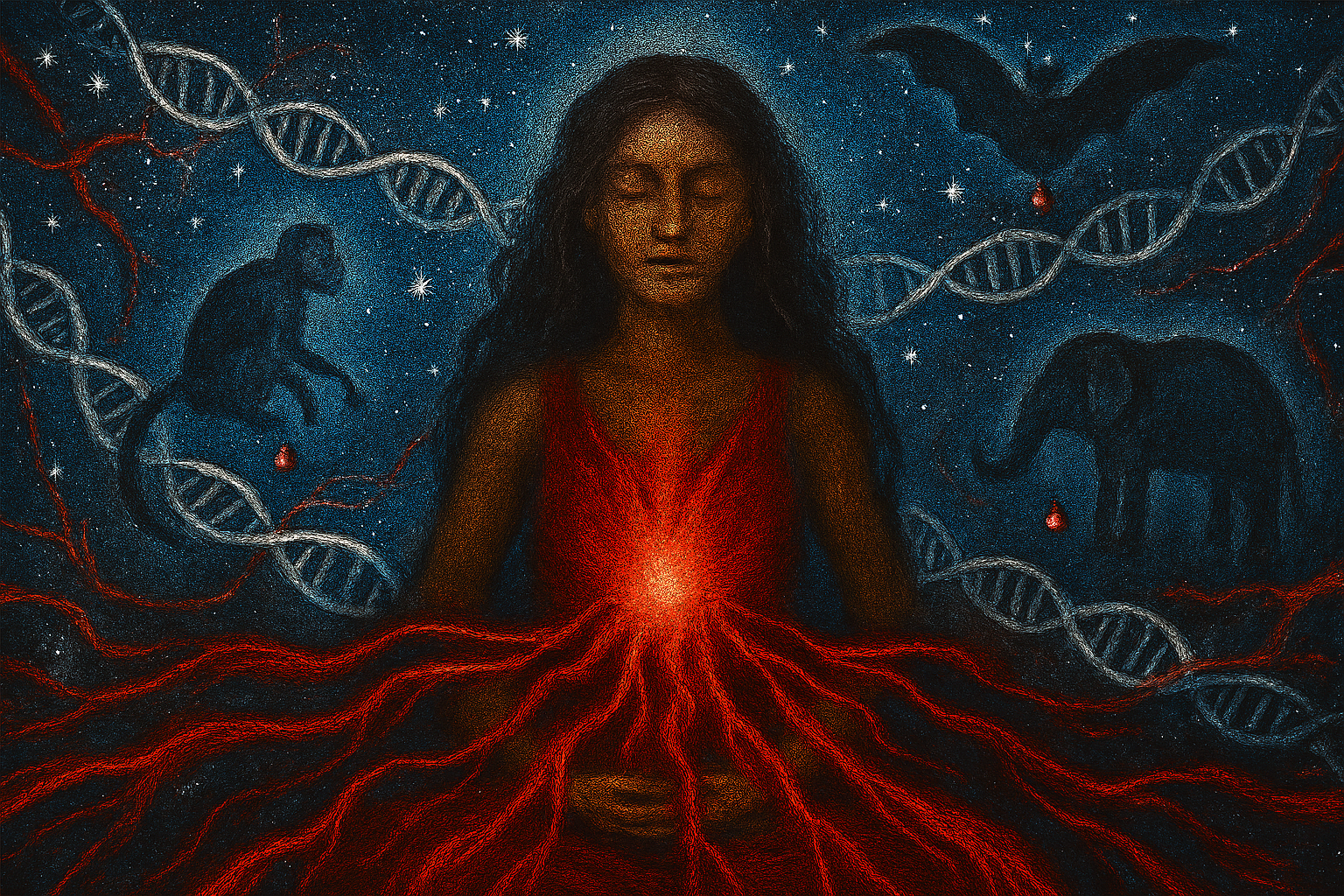
A menstruating woman becomes a walking goddess.
Cultural Wisdom and the “Taboo”
Cultural customs around menstruation—seclusion, rest, refraining from cooking, temple restrictions—are often dismissed as repressive taboos. But looked at differently, many of these practices carried practical and spiritual wisdom.
Ayurveda, the ancient Indian science of life, sees menstruation not as a curse but as a cleansing power intimately connected to the body’s energy flow. To rest during menstruation is not laziness but alignment with nature. To refrain from certain activities is not exclusion but preservation of energy.
The narrative of “shame” around menstruation is largely modern. In traditional settings, menstruation could also be seen as an initiation, a recognition of cyclical power. Elders might have viewed it as a time to retreat, reflect, and regenerate.
We have lost that symbolic literacy. Today, women are encouraged to push through pain, suppress symptoms, and carry on as though nothing unusual is happening. Cramps, exhaustion, mood swings are pathologized rather than understood. In part, this is because we see menstruation only biologically, not energetically. Women know what is happening in their bodies on a physical level. But on a deeper level, many lack a connection to what is happening spiritually and energetically.
This disconnection intensifies suffering. Pain becomes meaningless instead of meaningful. Fatigue feels like failure instead of an invitation to rest.
Menstruation, Evolution, and Human Origins
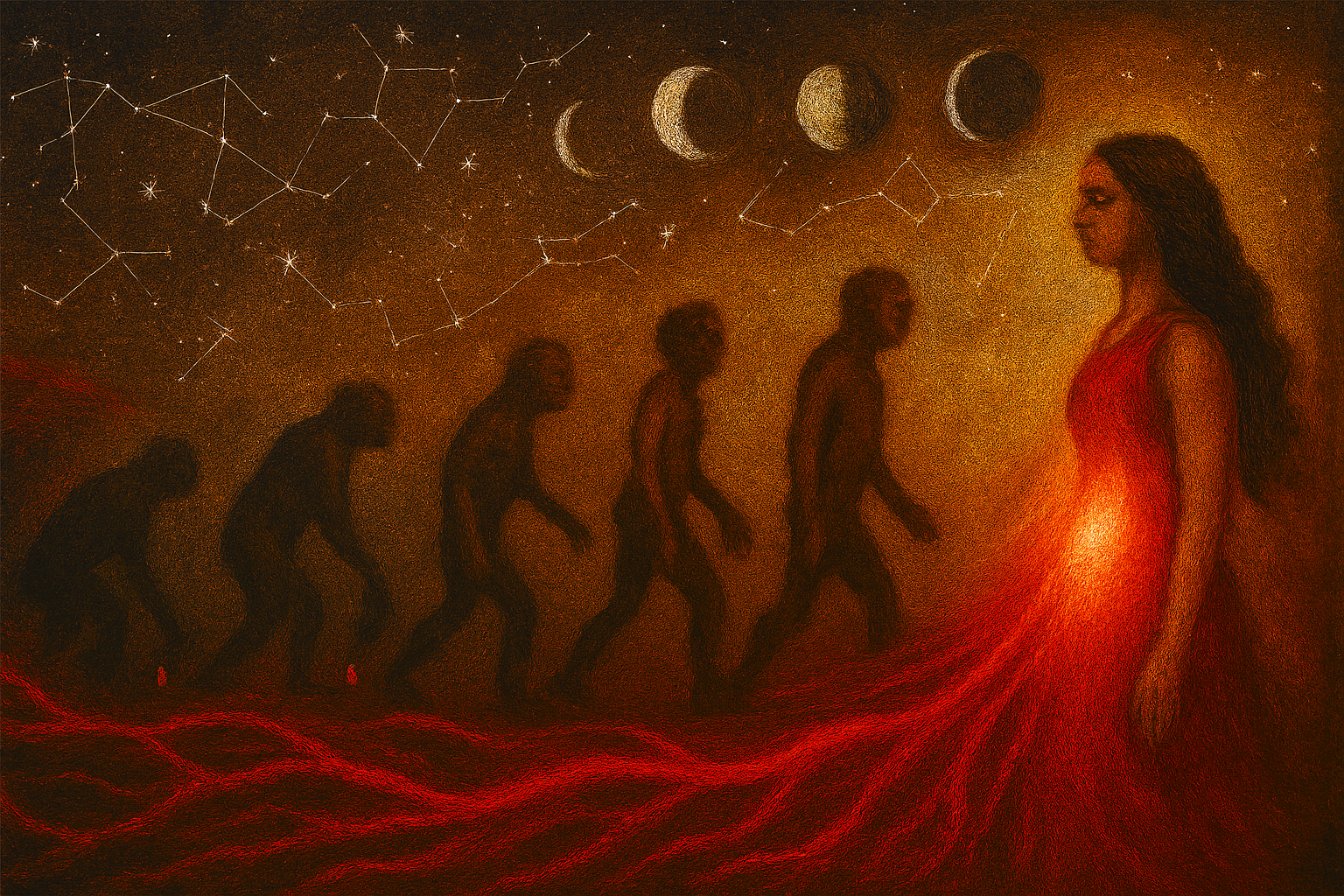
Menstruation is not only about reproduction. It has shaped human sexuality, behavior, and even evolution itself. Leonard Shlain, in Sex, Time, and Power, argued that menstruation influenced the development of human culture and sexuality in profound ways. By making female fertility both cyclical and visible, menstruation reshaped human mating patterns, relationships, and social dynamics.
Seen in this light, menstruation is not an isolated monthly nuisance but a driving force in the story of humanity. It shaped how we pair-bond, how we organize families, and how we evolved symbolic thought and culture.
A Journey Beyond Biology
This series, The Menstruation Papers, begins here: with the recognition that menstruation is at once biological, cultural, energetic, and philosophical. It is not only a matter of uterine lining and hormones, but also of mystery, pain, symbolism, and power.
To reduce it to “hygiene management” is to miss the depth of what is truly happening.
We will examine menstrual customs not with judgment, but with curiosity. We will look at science not as the final word, but as one lens among many. And we will explore how menstruation is deeply connected to human origins, psychology, sexuality, and even philosophy.
Menstruation is not a curse, nor merely a cycle. It is a mirror into the human condition—our biology, our culture, and our evolving relationship with nature and the sacred.
This is only the beginning.
Originally published on Substack — view source