February 18, 2025
Prescriptions from the Periodic Table-Mercury
Of Roman Gods, Pink babies and mistaken theories.
The dangers of toxic metals has plagued the human race throughout history. While ancient Romans struggled with lead poisoning, Chinese emperors faced their own deadly encounters with arsenic and mercury. One notable example was Qin Shi Huang, First Emperor of the Qin Dynasty (246–221 BCE), whose obsession with immortality led to his downfall.
In his quest for eternal life, Qin dispatched search parties across his empire to find the secret. Ironically, his own alchemists hastened his death by preparing mercury-based medicines, believing the silvery liquid held the key to immortality. The emperor died at just 49 years old, poisoned by the very substance he thought would save him.
**Quicksilver: A Deadly Beauty
**Elemental mercury, with its mesmerizing silvery sheen, is best known to most people as the liquid once commonly found in glass thermometers. Children of the 1990s may remember the fascination of playing with mercury from broken thermometers, watching the gleaming droplets scatter and roll across surfaces in an enchanting display. However, this captivating substance harbors a dangerous secret—while accidental ingestion is often discussed, mercury’s true danger lies in its toxic vapors, which can prompt entire building evacuations when even a single thermometer breaks.
The element’s mystique is reflected in its various names. “Quicksilver,” its evocative historical nickname, hints at its unique properties. Its ancient Latin name, *hydrargyrum* (meaning “water silver”), not only describes its remarkable liquid-metal nature but also gave rise to its chemical symbol Hg on the periodic table. Mercury holds several distinctions: it’s the only metal that remains liquid at room temperature, and it stands alone as the only element whose common name derives from both alchemical tradition and Roman mythology.
Mercury and the Age of Heroic Medicine
Why did toxic metals suddenly become a major health crisis in the early 1800s, despite their known dangers over centuries of use? The answer lies in the revival of an ancient medical theory that began in the 1780s, known as “Heroic” medicine. This approach revived Hippocrates’ concept that illness resulted from an imbalance of the four humors: black bile, yellow bile, phlegm, and blood.
The Heroic approach to restoring balance was aggressive and excessive. While bloodletting by the liter and sweat lodges had been practiced for millennia, this era saw these treatments applied with unprecedented intensity—ultimately causing more deaths than cures. During this period, purging became a cornerstone of medical treatment, leading doctors to liberally prescribe mercury-based medicines for virtually any ailment.
Even infants weren’t exempt from these dangerous treatments. Dr. Stedman’s Teething Powder, marketed as “Absolutely Safe and Harmless,” was essentially powdered mercury pills. Rather than being applied to the gums, it was placed on the infant’s tongue and washed down with milk, intended to purge whatever was causing their “imbalance.” The affected baby’s hands and feet would become icy, swollen, and red. The flesh would split off, resembling blanched tomatoes whose skins peeled back from the fruit. Babies also lost weight, cried petulantly, and clawed at themselves from the intense itching, tearing the raw skin open. Sometimes her fever reached 102 degrees.
In 1921, they called this affliction which only affected babies Pink’s Disease, and doctors were seeing more and more cases every year.
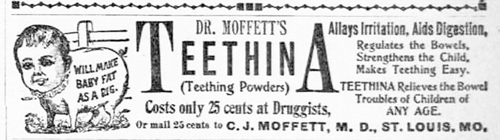
A baby-pig hybrid monster on the package of mercury-based ‘teething powder’
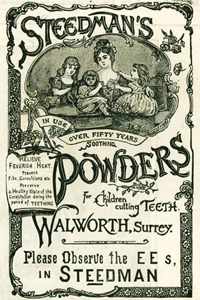
Spelling is everything if you’re going to poison your kids
The market was flooded with various mercury and arsenic-based medications. Ironically, opiates—now illegal in many states—were among the few medicines prescribed during this era that didn’t typically prove fatal.
Mercury, like other metals, primarily attacks three major body systems: neurological, gastrointestinal, and renal (kidney). While elemental mercury—the raw, silvery compound—was seldom used as medicine except in medical instruments, a different form called calomel became the purgative of choice during this era. Although calomel was poorly absorbed by the intestines, the massive “heroic” doses being prescribed ensured enough entered the body to cause significant damage.
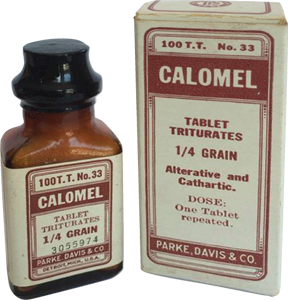
“Dose: One tablet repeated” (until all hell breaks loose in the toilet)
The name “calomel” derives from Greek words meaning “good” and “black”—referring to its tendency to turn black when exposed to ammonia. Despite its similar-sounding name, this substance bears no relation to either calamine lotion or caramel. Some historians suggest the “black” in its name may have come from the dark stools it produced, which doctors mistook for purged bile. This aligned perfectly with ancient Hippocratic and Galenic theories about maintaining balanced humors and allowing bile to flow freely. The logic followed that since the bowels were naturally dark and slimy, expelling such matter must be beneficial.
Calomel dominated medicine from the sixteenth through early twentieth centuries. One of its most dramatic effects was excessive salivation—a telltale sign of mercury poisoning. Patients would drool so profusely they could rival a rabid dog. In the sixteenth century, the physician Paracelsus considered treatment successful only when patients produced at least three pints of saliva. During this era of overflowing chamber pots and streams of saliva, physicians embraced calomel as their miracle cure.
Benjamin Rush, a founding father and Declaration of Independence signatory, exemplified this medical mindset. Though progressive in many ways—supporting women’s education, opposing slavery, and advocating humane treatment of psychiatric patients—he firmly believed in calomel’s power to treat mental illness. His prescription for hypochondria outlined three benefits:
Redirecting “morbid excitement” from brain to mouth
Clearing internal blockages
Shifting patients’ focus from imagined ailments to their very real mouth pain
Rush noted that treatment proved even more effective if it sparked resentment toward the doctor or patient’s family.
In reality, Rush was replacing hypochondria with severe mercury poisoning. Patients developed mercurial erethism, a neurological condition characterized by depression, anxiety, pathological shyness, and frequent sighing—symptoms that, combined with limb tremors, became known as “mad hatter’s disease” or “hatter’s shakes” (named after hat-makers who used mercury in felt processing). The physical toll was equally severe: patients lost teeth, suffered rotting jawbones, and developed gangrenous cheeks that created facial holes, exposing ulcerated tongues and gums. Rush’s treatment effectively transformed his patients into morose, zombie-like figures.
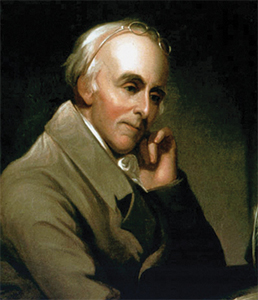
sdhlsdf Benjamin Rush, founding father, wants you to poop excessively…
During Philadelphia’s 1793 Yellow Fever outbreak, Dr. Rush became notorious for his extreme use of “heroic depletion therapy”—combining massive doses of calomel (sometimes ten times the normal amount) with aggressive bloodletting. His methods proved so extreme that even the purge-friendly Philadelphia College of Physicians condemned them as “murderous” and “fit for a horse.” Author William Cobbett had already branded Rush a “potent quack” in 1788.
The devastating impact of Rush’s treatments became clear through the numbers. While Thomas Jefferson estimated the Yellow Fever’s general fatality rate at 33 percent, a 1960 study revealed that 46 percent of Rush’s patients died. Ironically, what ultimately ended the epidemic wasn’t Rush’s treatments but his work improving Philadelphia’s standing water and sanitation issues, combined with the arrival of autumn’s first frost, which killed the disease-carrying mosquitoes.
Even Rush’s friend Alexander Hamilton rejected his treatments when he fell ill, choosing a doctor with gentler methods instead. Hamilton later wrote, “In his theory of bleeding and mercury, I was ever opposed to my friend … whom I greatly loved; but who had done much harm, in the sincerest persuasion that he was preserving life.” Hamilton survived, but Rush’s medical practice collapsed by the century’s end.
Despite Rush’s fall from grace, his influence extended far beyond Philadelphia through “Dr. Rush’s Bilious Pills”—a mixture of calomel, chlorine, and jalap (a powerful herbal laxative). These pills, nicknamed “Dr. Rush’s Thunderbolts” or “Thunderclappers,” even made their way onto Lewis and Clark’s famous expedition. Rush’s instructions were remarkably consistent: for the slightest illness, “gently open the bowels by means of one, two, or more of the purging pills.” He prescribed them for constipation, which he saw as “often a sign of approaching disease,” and even loss of appetite, considering it “a sign of approaching indisposition” requiring “the same remedy.”
Remarkably, calomel remained in medical use until the mid-twentieth century, when a better understanding of heavy metal toxicity finally ended its reign.

In summary, if anything felt off? Purge. Purge like hell…
The Lewis and Clark expedition carried an impressive supply of 600 Dr. Rush’s Thunderbolts on their journey. Modern historians made a fascinating discovery in Lolo, Montana, that confirmed the explorers’ presence—through their waste, of all things. Following military protocol, which required latrines to be placed 300 feet from main campsites, researchers first located the camp using dated lead samples. Sure enough, they detected mercury deposits exactly 300 feet away, providing definitive proof of the expedition’s presence. While the effectiveness of Rush’s mercury-laden pills remains debatable, they left an undeniable legacy—one that allowed historians to trace the expedition’s path through an unexpectedly scientific analysis of their bodily waste.

Abraham Lincoln, pre-beard, pre-hat, and not mercury-free.
Even Abraham Lincoln, before his presidency, fell victim to mercury’s toxic allure. In the 1850s, he struggled with mood swings, headaches, and constipation. An aide documented Lincoln’s use of “Blue pills” or “blue Mass,” noting, “[W]hen he hed no passages he always had a sick headache.” These “sick” or “bilious” headaches were thought to be curable through cathartics that promoted bile flow.
This “blue mass” was a peculiar concoction: a peppercorn-sized pill containing pure liquid mercury mixed with licorice root, rosewater, honey, and sugar. Though liquid mercury typically resists intestinal absorption, druggists improved its potency through a process called extinction—repeatedly pounding the mercury beads into submission, perhaps channeling their own repressed aggression. Ironically, this violent compounding process made the mercury more dangerous, as it could now be absorbed in vapor form within the intestines.
Like drinking mislabeled decaf coffee, Lincoln’s mercury treatment only worsened his condition. Contemporary accounts describe his increasingly erratic behavior: violent mood swings between depression and rage, coupled with insomnia, tremors, and unusual gait—all potential symptoms of mercury poisoning. He may have developed erethism, like many mercury victims before him.
Fortunately, Lincoln demonstrated remarkable self-awareness by recognizing that blue mass might be exacerbating his condition. He reduced his usage upon entering the White House—a timely decision indeed. One can only imagine the potential consequences of having a mercury-addled, emotionally unstable commander-in-chief during the Civil War.
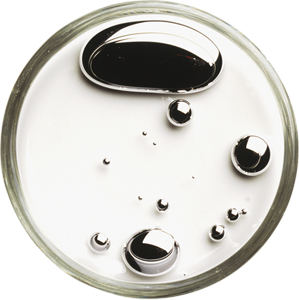
Mercury/ quicksilver
Mercury poisoning is not a something which only happened in antiquity. In August 2018, a case of mercury poisoning was recorded:


Originally published on Substack — view source